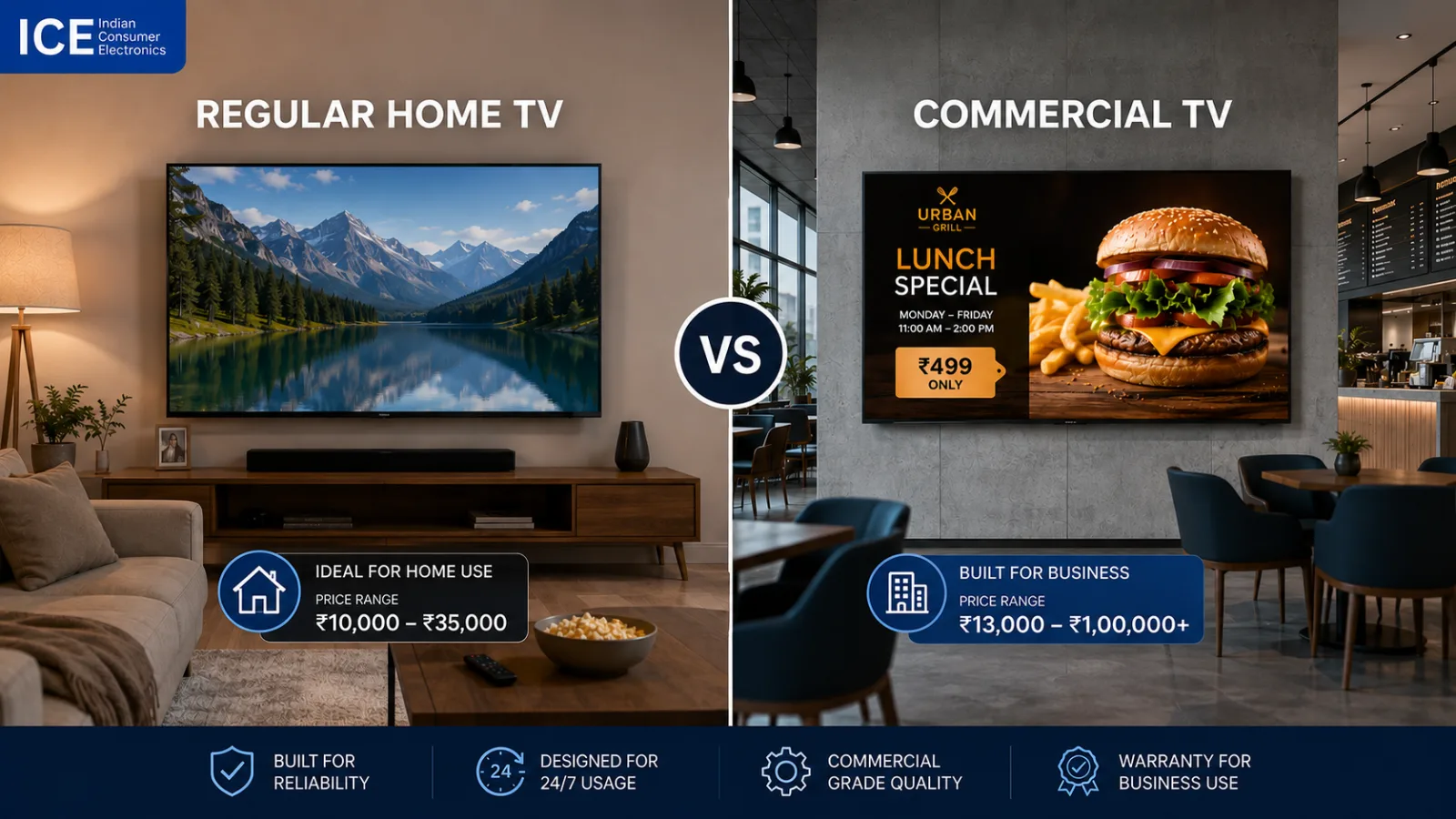
Difference Between Commercial TV and Regular TV
A commercial TV is a display screen built specifically for business digital display needs — designed to run continuously, handle higher brightness, and withstand conditions that would break a regular home television within months.
If you run a restaurant, café, or retail outlet and are thinking about putting up a screen to show your menu or promotions, understanding this difference can save you a lot of money and frustration.
This article covers exactly what separates a commercial TV from a regular TV, why it matters for your business, and how to pick the right one.
What Is a Commercial TV and How Does It Differ from a Consumer TV
From the outside, a commercial TV and a regular TV can look almost identical. Same flat panel, same bezels, similar sizes. But the engineering inside is built for completely different use cases.
A regular home television is designed to run six to eight hours a day — that is how Sony, Samsung, and LG test and rate their consumer panels.
A commercial display, on the other hand, is built to run 24 hours a day, 365 days a year, without the backlight or inverter board giving up on you mid-service.
In our experience working with restaurants and cafés across Bengaluru, Coimbatore, and Hyderabad, the most common failure we see with regular TVs used commercially is backlight failure — and fixing it costs nearly 60% of the original TV's purchase price.
That is not a one-time hit either. Once a regular TV starts failing under commercial load, the repairs keep coming back every few months.
Commercial TVs also run 30–40% brighter than consumer TVs. That extra brightness is not for show — in a busy restaurant with overhead lighting or a café with natural light coming through the windows, a regular TV simply looks washed out.
Key takeaway: If your screen will be on for more than 8 hours a day in a customer-facing area, you need a commercial TV — not a home television with a commercial price tag.
Why Regular TVs Fail Faster in Restaurants and Cafés
We have had this conversation with dozens of restaurant owners across South India, and the story is almost always the same.
They bought a regular 43-inch Android TV because it was ₹3,000–₹12,000 cheaper than the commercial equivalent. Within six months, the backlight started flickering.
By the end of the year, they were looking at a repair bill that made the original saving look meaningless.
The physics here is straightforward.
A commercial TV generates significant heat during continuous operation. Consumer TVs are not built with the heat dissipation systems needed to handle that.
The internal components — particularly the backlight and inverter board — start degrading under sustained thermal stress. Commercial displays are engineered specifically to manage this heat load and keep running reliably.
We have worked with one client whose business turns over close to ₹1,400 crore annually. Money was not their concern — reliability was. Even they faced repeated failures after deploying regular TVs in their dining areas.
Commercial TVs are roughly 25–35% more expensive upfront than equivalent consumer TVs.
When you compare that to repair costs that can hit 60% of the TV's value — and come back again and again — the commercial TV is clearly the more economical choice over any meaningful time horizon.
Practical Suggestion: Do not compare the purchase price alone. Compare total cost of ownership over two to three years. That is where commercial TVs consistently win.
Smart TV Signage and Digital Display Integration for Restaurants
One of the biggest advantages of a commercial TV over a regular Android TV for restaurants is what you can do with it beyond just playing a video.
Most commercial displays support digital signage software integration out of the box. With a cloud-based CMS like ICE Signage, you can manage what plays on every screen in your restaurant — menus, offers, combo deals, event promotions — from a single dashboard on your phone or laptop.
You can schedule a lunch menu to appear at 11:30 AM and switch automatically to dinner specials at 6:00 PM without touching the screen.
A regular Android TV can technically run a signage app, but it is not optimised for it. Boot loops, app crashes after updates, and the TV reverting to its home screen mid-service are all issues we hear from restaurant owners who tried this route with our own consumer TVs as well.
Commercial displays run dedicated signage software in a locked environment — they boot directly into your content, stay there, and do not wander off to suggest Netflix shows and OTT Apps to your customers.
For restaurants with multiple locations in, say, Bengaluru and Mysuru, a commercial display setup with cloud-based digital signage means you can update your menu pricing or add a new promotion across all locations simultaneously, from one place.
If you want your screens to work as a reliable sales tool — showing the right content at the right time without someone babysitting them using pendrives and remotes all the time — pair commercial displays with proper digital signage software.
Commercial TV Applications by Industry — Where It Makes the Most Sense
Commercial TVs are used across a wide range of business environments, and the use case is what specification you actually need.
- Restaurants and QSR chains: Digital menu boards, promotional displays at entry points, combo meal upsell screens near the counter. Brightness of 300 (Smaller Screens) –700 nits (Larger Screens) works as well for most indoor restaurants.
- Cafés and bakeries: Menu boards above the counter, ambient display screens for ambience or promotions. A 32" or 43" commercial display handles most café setups well. The size should be selected based on the avaliable space at the location.
- Hotels and hospitality: Lobby information displays, latest offers, restaurant menu screens within the property.
- Retail outlets and malls: Outdoor Promotional display screens, wayfinding boards, window-facing displays that need higher brightness (2,500–5,000 nits for outdoor or semi-outdoor placement).
- Corporate offices: Meeting room displays, lobby information screens, cafeteria menu boards.
For restaurants specifically, the digital menu board use case is where commercial TVs deliver the most visible return. Customers spend more time looking at well-lit, clearly displayed menus — and that directly affects average order value, particularly during peak hours like weekend evenings.
How to Choose the Right Commercial TV for Your Restaurant or Business
There is no single answer that works for every business, but there are a few clear questions that help narrow it down quickly.
- How many hours a day will the screen be on? More than 10 hours — commercial TV only, no exceptions.
- Where will it be placed? Near a window or outdoors — you need higher brightness. Deep inside a dim restaurant — standard commercial brightness is fine.
- Do you need to manage content remotely? If yes, make sure the display supports your digital signage software, or buy a display that comes bundled with a CMS.
- How many screens? One screen at a single location is straightforward. Multiple screens across locations — you need a cloud-based signage solution to manage them efficiently.
- What is your budget? Commercial displays start from around ₹13,000–₹22,000 for a 32" panel (prices vary with GST and specifications). Factor in installation and the signage software subscription if relevant.
Brands like LG Commercial TV, ICE Commercial TV and Samsung Commercial TV have strong after-sales networks in India, which matters when you need service support in cities like Coimbatore or smaller towns.
BIS certification is mandatory for any display sold legally in India — always check for it before purchasing.
What is the difference between a commercial TV and a regular TV?
A commercial TV is built to run continuously — 18 to 24 hours a day — with stronger heat management, 30–40% higher brightness, and components rated for far longer operational life. A regular consumer TV is designed for 6–8 hours of daily home use. Running a consumer TV in a commercial setting typically causes backlight and inverter board failure within 6–12 months, with repair costs reaching 60% of the original TV price.
What is a commercial TV used for?
Commercial TVs are used in restaurants as digital menu boards, in hotels as in-room hospitality displays, in retail stores for promotional screens, and in corporate offices for lobby and meeting room displays. Any environment where the screen runs for extended hours and needs to display business content reliably is a good fit for a commercial TV.
Are commercial TVs worth it for small businesses?
Yes, particularly for restaurants, cafés, and small retail outlets where a screen runs through an entire working day. The upfront cost is 25–35% higher than a consumer TV, but repair costs on consumer TVs used commercially can hit 60% of the purchase price and recur frequently. For most small businesses running screens 10+ hours daily, commercial TVs cost less over a two-year period.
Can you use a commercial TV at home?
Technically yes, but it is not the right tool for home use. Commercial TVs are optimised for content management, continuous operation, and signage software — features that offer no benefit at home. They are also priced for business durability, not home entertainment value. A good consumer TV is the better and more cost-effective choice for home use.
What brands make the best commercial TVs for Indian businesses?
LG Commercial TV, ICE Commercial TV and Samsung Commercial TV are the most widely used brands in India, with strong service networks across major cities including Bengaluru, Hyderabad, Mumbai, and Chennai. ICE Group offers commercial displays with BIS certification and cloud-based digital signage integration suited specifically to Indian restaurant, retail, and hospitality environments.