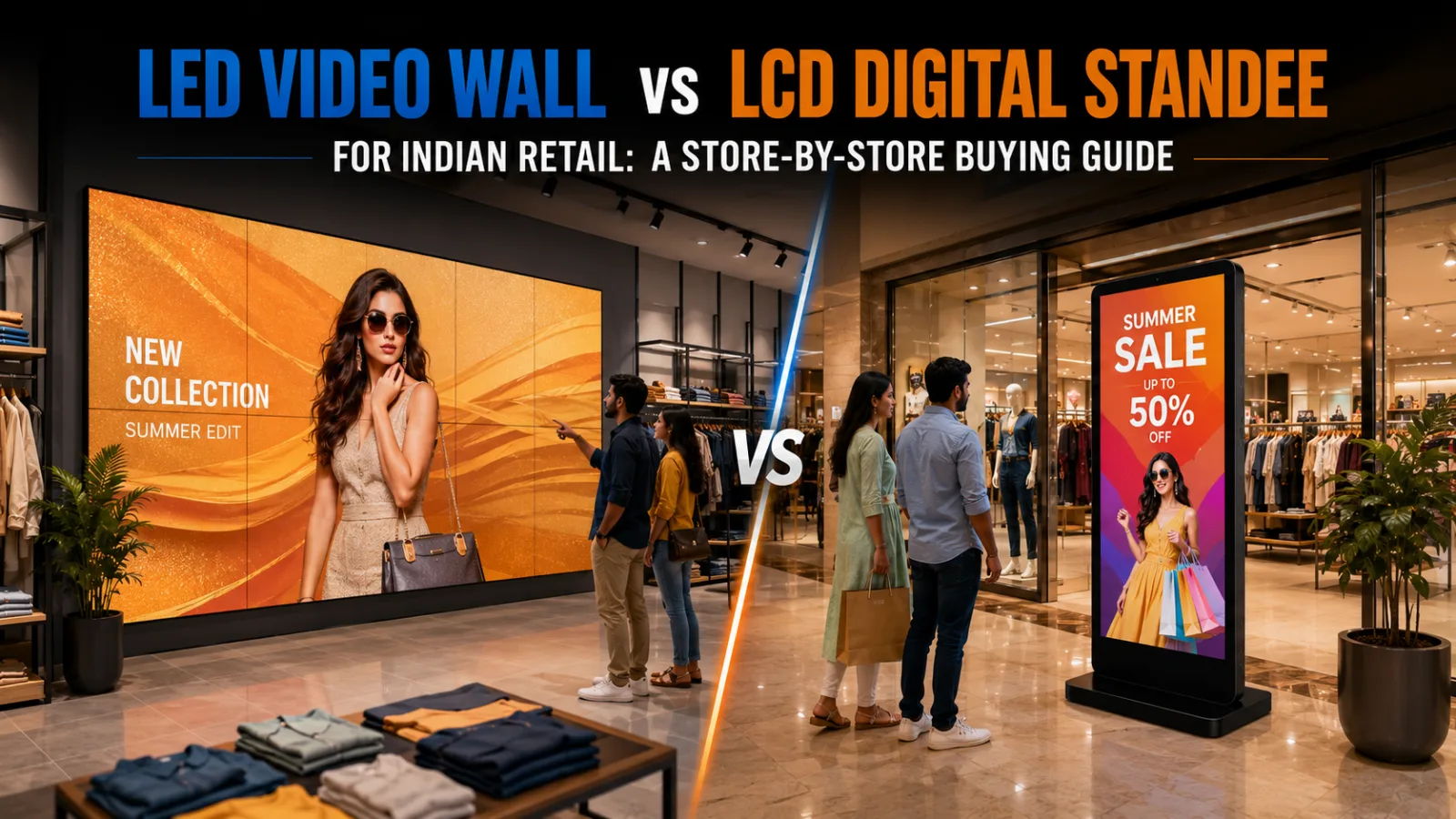
LED Video Wall vs LCD Digital Standee for Indian Retail: A Store-by-Store Buying Guide
A digital standee is a freestanding commercial display screen like ICE Commercial TVs that is typically a slim, floor-standing unit and it plays video, images to attract and inform customers.
For Indian retail businesses, it is one of the most cost effective and attractive way to replace printed flex or paper banners and posters with a live, updatable advertising content.
This article is written my 10 years of experience in the industry building and scaling one of the major signage hardware and software brands of India. It will cover everything you need to choose between a digital standee and an LED video wall, including size, placement, price, and the exact store types where each makes financial sense. Haha, That last point is very important for our Indian Market.
What Is a Digital Standee and How Does It Work?
A digital standee is a floor mounted digital display unit with a built in media player, designed for indoor advertising in retail shops, restaurants, QSRs, malls, hotels, corporate lobbies, and showrooms.
The screen is fit inside a slim metal cabinate usually portrait orientation and a few also prefer landscape or horizontal orientation and plays content on a loop from a USB drive or cloud based content management system like our ICE SIgnage.
The working principle is very simple. Infact much easier like using whatsapp. You load your promotional content such as a product video, an offer banner, a brand film into the device. The built in processor runs it continuously.
With a cloud CMS like ICE Signage, you can update content remotely across every standee in your store network from a single dashboard, without physically visiting each location.
Most valued digital standees sold in India today use commercial grade LCD panels with LED backlighting, which gives them better brightness and longer running hours than consumer TVs. They are rated for 16/7 or 24/7 operation, which consumer televisions simply are not built for. You can read about it in our comparison article: Difference Between Commercial TV and Regular TV
Where Can You Use a Digital Standee?
The short answer is: anywhere customers wait, walk past, or pauses. The longer answer depends on the footfall pattern of the location and light in your specific space.
- Retail stores: Near the entrance to pull walkins, or at the billing counter to promote add ons.
- Shopping malls: Outside your store the standee facing the corridor, or inside near highvalue product displays
- QSR and restaurant chains: At the entrance displaying today's specials, or beside the counter showing combo offers. Like KFC Showing Wednesday Specials
- Hotel lobbies: Showing event schedules for their conference and function halls, restaurant menus.
- Corporate offices: Reception areas for visitor information, HR communications, or brand messaging
- Pharma and clinic chains: Waiting areas for health awareness content, health memberships promotions, top doctors and surgeons display.
We have installed digital standees in everything from a single outlet clothing boutique in Koramangala, Bengaluru, to a 40 store pharmacy chain across Tamil Nadu. The use case stays consistent all across replace static prints with dynamic, updatable digital content. Obviously business also need sales and marketing automations today.
Indoor vs Outdoor Digital Standee: Key Differences
This is where many buyers make an expensive mistakes. Here is our real life experience, An indoor digital standee placed in direct sunlight even under a covered porch or near a glass façade will wash out completely and overheat within weeks. We experienced this when we supplied a digital standees to Tommy Hilfiger outlet opposite to AMC College, Bangalore.
Indoor units typically run at 400–700 nits of brightness maximum, which is perfectly fine for a climate controlled store interior. Outdoor or semi-outdoor units need a minimum of 2,500 nits of brightness and full direct sun installations need 4,000–5,000 nits. Our ICE commercial display range covers both ends of this spectrum, Speak to our product expert before you place the order.
The other differences are equally important:
- Weatherproofing: Outdoor standees carry an IP65 rating sealed against dust from roads and water while rain and cleaning. Indoor units do not need this.
- Temperature tolerance: Indian summers in cities like Delhi, Mumbai, Hyderabad and Coimbatore regularly hit 42–45°C. Outdoor units have active cooling systems to handle this.
- Vandal resistance: Outdoor facing screens use toughened glass with anti glare coating to avoid refraction with toughened glass.
- Power consumption: A 55 inch outdoor unit consumes roughly 180 220W power, You should factor this into your running cost calculations.
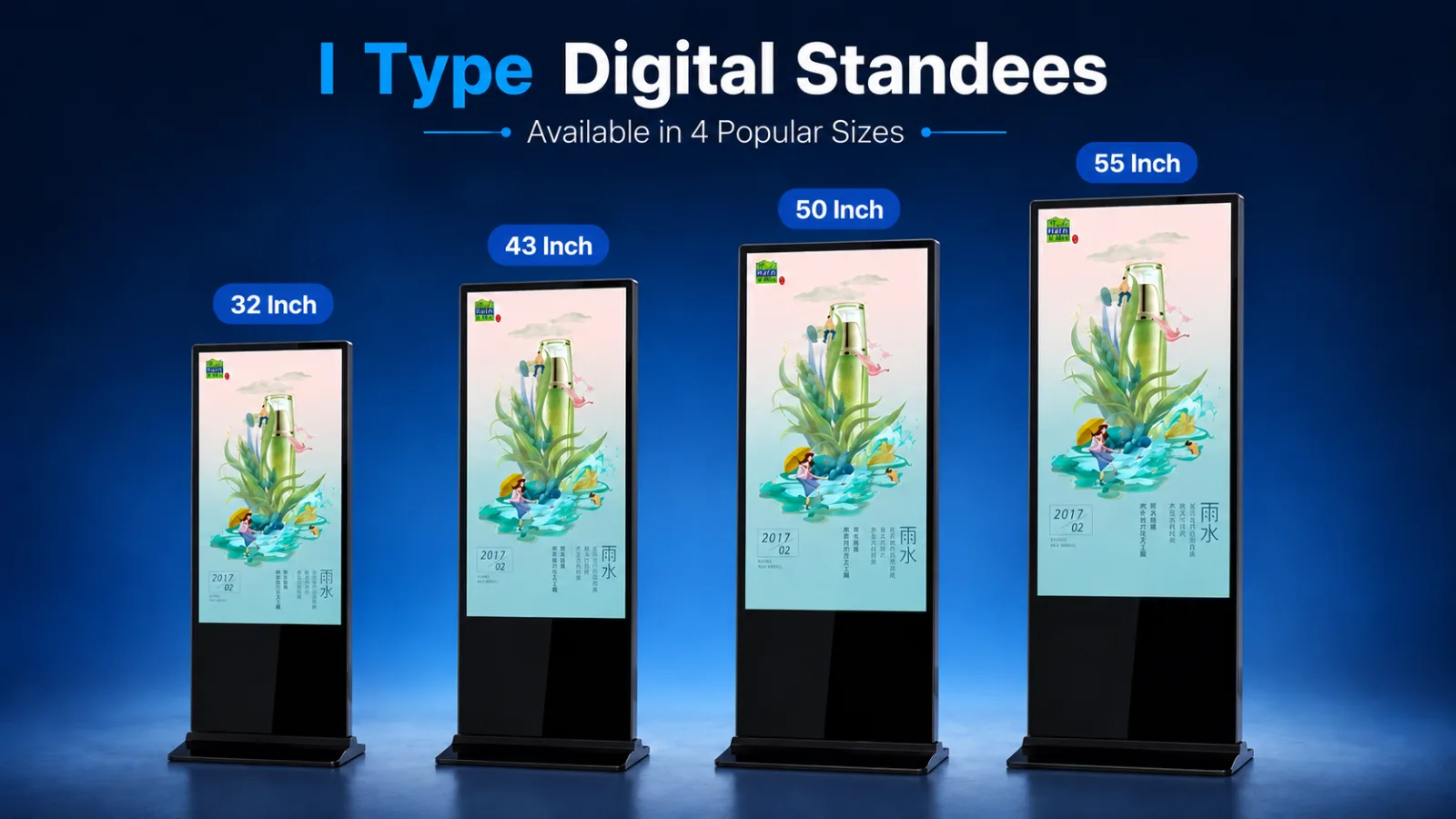
Digital Standee Size Guide: 32, 43, 50, 55 and 65 Inch Compared
Screen size is not just only about budget, it is about viewing distance and store dimensions. Here is how the common sizes map to real retail situations in India:
- 32 inch: Best for narrow countertops, shall QSR, pharmacy dispensing counters, or tight corridor installations. Viewing distance up to 2.5 metres.
- 43 inch: The most popular size for small to mid retail stores. Works well at entrances and beside checkout counters to promote add on offers . The ideal viewing distance 3–4 metres.
- 50 inch: Good choice for midsize showrooms, restaurant entrances, and hotel lobbies. Viewing distance 4–5 metres. This is what we have installed in Indies 365 Restaurant Chain in Sadashiva Nagar & Gandhi Nagar.
- 55 inch: Our most recommended size for retail chains. Enough screen real estate to show product images clearly without dominating a 300–600 sq ft store.
- 65 inch: Surely reserve this for flagship stores, large showroom floors, or mall corridors with 6+ metre viewing distances. Running costs are higher, and the standee base needs to be weighted properly.
Content resolution matters here too. A 4K UHD display at 55 inches shows clothing textures and jewellery details at a level that genuinely influences purchase decisions, especially in lifestyle and fashion retail. While full HD 1920X1080p content works well for indoor outlets.
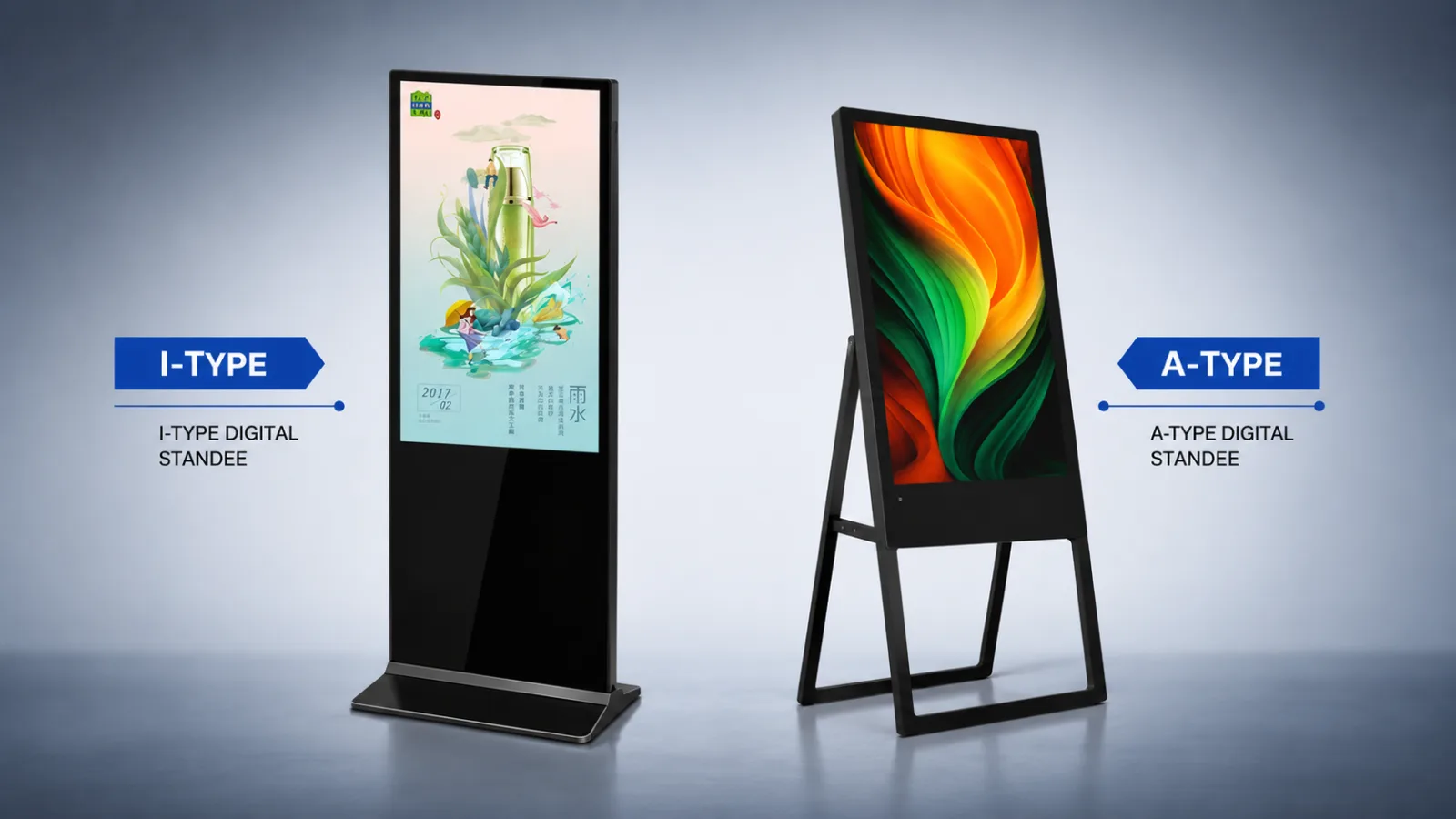
A-Frame vs I-Shape Digital Standee: Which Design Suits Your Space?
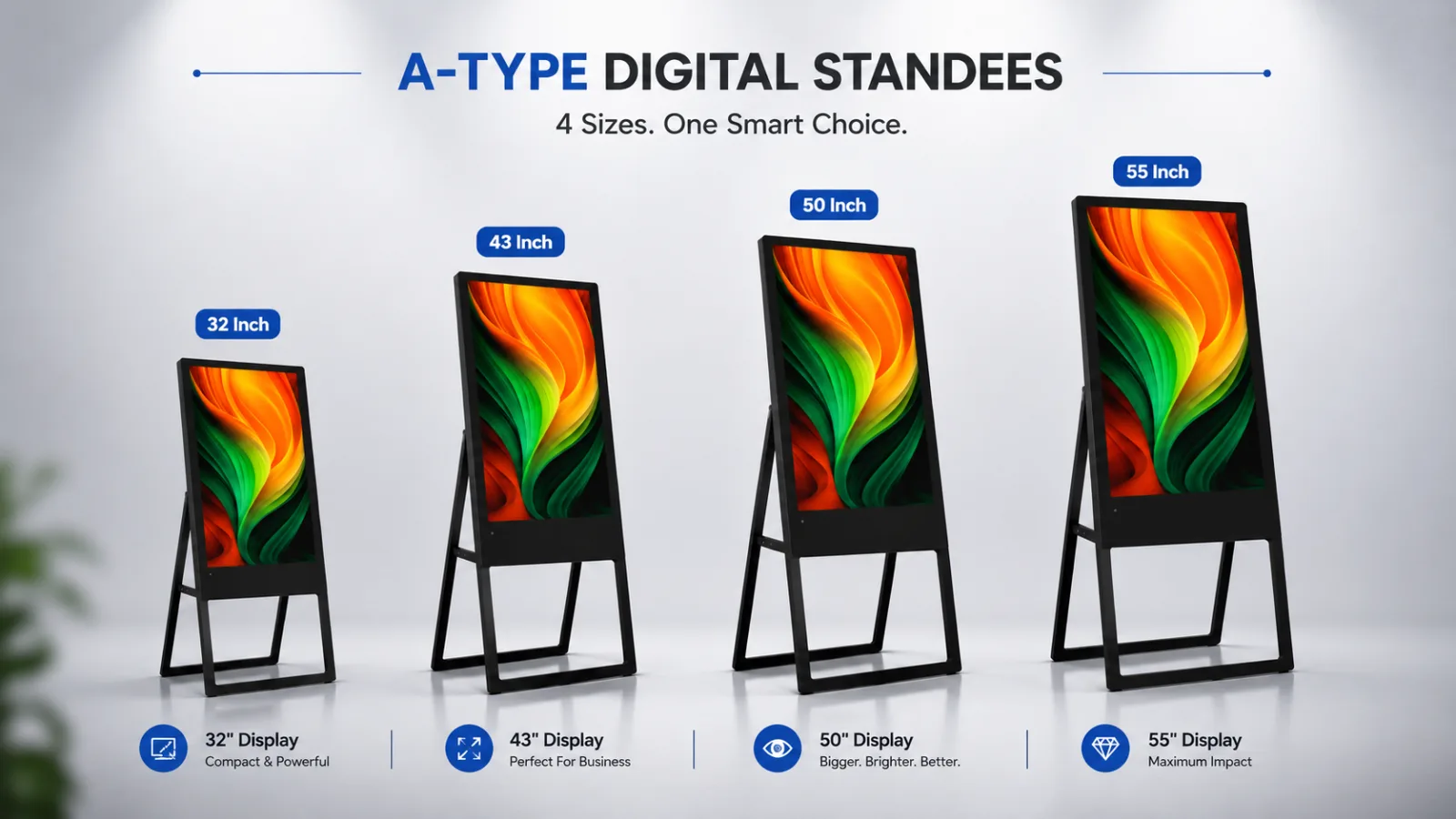
The two most common form factors you will see from any digital standee manufacturer are the A-frame and the I-shape
The I-shape standee has a single screen facing one direction, mounted on a slim rectangular base. It is lighter, easier to move, and takes up less floor space typically a 40x40 cm footprint. This is the right choice for stores where you have one primary customer flow direction, like a mall unit where all foot traffic comes from one corridor.
The A-frame Digital Standee has screens on both faces or single side based on the config, so it shows content to customers approaching from two directions. This is ideal for corner plots, standalone kiosks in mall atriums, or stores with entrances on two sides. The trade-off is weight, cost (roughly 1.6–1.8x the single-face price), and power — you are running two screens.
Digital Standee vs LED Video Wall: A Store-by-Store Comparison
This is the central question for any growing retail brand, and the honest answer is that both are right — for very different situations.
A case documented by Sparsa Digital gives a useful benchmark here. An Indian apparel retail chain rolled out LED video walls across 50 flagship stores nationwide. These were not simple promotional loops the brand ran high-definition runway footage, influencer content, and live product demonstrations.
The results after three months were concrete: foot traffic rose 23% and same-store sales climbed 18%. Social shares of in-store screens also increased measurably, which added an organic reach dimension the brand had not originally planned for.
That outcome makes the case for LED video walls convincingly. But it also makes the countercase just as clearly. A 50 store LED rollout is a serious capital commitment typically ₹2–3 lakh per store installation depending on wall size and pixel pitch. It only pays off when you have flagship-scale footfall, strong content production behind it, and the staff bandwidth to manage what is effectively a media operation inside a store.
For a retailer running 3–10 mid-size stores in cities like Mysuru, Coimbatore, or Kochi, a well-placed 55 inch digital led standee at ₹45,000–₹80,000 per unit delivers most of the same customer attention benefits at a fraction of the investment.
Digital Standee for Retail Stores and Shopping Malls
Shopping malls in India have specific rules around in-corridor advertising, and digital signage standees are usually the permitted format when you cannot mount screens on the exterior wall.
Most mall management offices in Bengaluru, Chennai, and Hyderabad allow one or two standees in front of a store unit within a defined footprint — typically 60x60 cm base area.
For instore use, the return on a digital standee comes from three specific behaviours it influences.
First, it stops the walkpast customer at the entrance motion content on a display screen is simply more attention grabbing than a static poster.
Second, it communicates an offer or product story without requiring a staff member to do it. I mean a a salesman without leave and salary like we promote in our ads.
Third, it builds a perception of the brand a store with a live, well-designed digital display looks more established than a store with a printed vinyl banner.
Retail chains in the apparel, electronics, jewellery, and QSR categories in India are currently the heaviest adopters of digital standees as per what we have seen.
Jewellery showrooms in particular benefit from 4K displays that show product texture and finish with a level of detail printed photographs cannot match.
Digital Standee Technical Specifications to Check Before Buying
When you are getting quotes from a digital standee manufacturer, these are the specifications that actually matter — not the marketing language around them.
- Panel type: IPS panels give better colour accuracy and wider viewing angles than TN panels. For retail, always specify IPS.
- Brightness: Minimum 300 nits for indoor retail. 700 nits if you are near a glass façade or high ambient light area.
- Resolution: Full HD (1920x1080) is acceptable for most content. 4K UHD makes a visible difference at 55 inches and above, especially for product closeups.
- Operating hours rating: Commercial units are rated 16/7 or 24/7. Consumer TVs are not rated for continuous commercial operation they will fail faster.
- Connectivity: HDMI input, USB media playback, and Wi-Fi/LAN for CMS connectivity. 5G enabled units allow remote management without a local network.
- Content management: Does it come with software, or do you need to buy a CMS separately? ICE Signage is our cloud based platform one dashboard manages any number of screens across multiple cities.
- Warranty: Minimum 1 year on site service warranty. Ask specifically about panel warranty versus unit warranty some manufacturers separate these.
What Does a Digital Standee Cost in India?
Prices vary by screen size, panel quality, and whether you are buying with or without a CMS subscription. Here is a realistic range for 2024–2025, excluding GST:
- 32 inch digital standee: ₹22,000–₹35,000
- 43 inch digital standee: ₹38,000–₹55,000
- 55 inch digital standee: ₹55,000–₹85,000
- 55 inch digital standee: ₹1,10,000–₹1,60,000
- Dual-side (A-frame) 43-inch: ₹70,000–₹1,00,000
GST on commercial display screens is currently 18%. If you are a GST-registered business, this is fully input tax creditable. For chains buying 10 or more units, volume pricing typically brings perunit cost down by 5 - 7% as per what we have seen at ICE Group.
ICE Signage CMS is priced as a monthly or annual subscription per screen contact us for current pricing based on your screen count and feature requirements.
Why Choose ICE Group for Digital Standee in Bengaluru
We are a Bengaluru-based commercial display manufacturing company with 10 years of industry experience in manufacturing ans relavent software and firmware development.
We are supplying to retail businesses, hotel chains, restaurant groups, QSR Brands, and corporate offices across South India and beyond.
Our digital standees are commercialgrade units — not repurposed consumer screens and every unit we supply comes with onsite installation, commissioning, and post-installation support.
We also supply the content side of the equation. ICE Signage, our cloud-based digital signage CMS lets your team update offers, prices, and campaigns across all your screens without technical knowledge.
During high-traffic periods like Diwali, summer sale season, or wedding season, you can push new content to every store in your network from a single login across multiple branches.
For businesses that want everything managed hardware, installation, content templates, and software we offer a complete package. For businesses that already have a CMS and just need reliable hardware, we supply screens on a standalone basis.
Whether you are running a single boutique in Indiranagar or expanding a 30 store retail chain across Karnataka and Tamil Nadu, the right digital standee setup is one that fits your store format, your content plan, and your actual budget not the one that looks most impressive in a product brochure.
What is a digital standee?
A digital standee is a freestanding floor display unit with a commercial-grade screen that plays video, images, or animated promotional content on a loop. It is used in retail stores, malls, hotels, and corporate lobbies as a replacement for printed banners and static posters. Content can be updated via USB, Wi-Fi, or a cloud-based content management system.
What is the price of a digital standee in India?
A 43-inch indoor digital standee in India costs approximately ₹38,000–₹55,000 excluding GST. A 55-inch unit ranges from ₹55,000–₹85,000. Outdoor-rated units are significantly higher — typically ₹1,10,000–₹1,60,000 for a 55-inch outdoor model. Volume discounts apply for orders of 10 or more units.
What are the uses of a digital standee?
Digital standees are used for in-store promotions, product launches, offer announcements, brand storytelling, and directional information. They are common in retail clothing stores, jewellery showrooms, QSR chains, hotel lobbies, pharma outlets, and corporate reception areas. The key advantage over printed displays is that content can be updated instantly without reprinting costs.
Which is better: digital standee or LED video wall?
An LED video wall creates higher visual impact and is better suited to flagship stores with strong content production capability and footfall above 1,000 visitors per day. A digital standee costs significantly less per unit, deploys faster, and is better for store rollouts across multiple locations. For most Indian retail chains with 3–20 stores, a digital standee delivers stronger return on investment.
Can digital standees be used outdoors in India?
Yes, but only units specifically rated for outdoor use. Outdoor digital standees require a minimum brightness of 2,500 nits, IP65 weatherproofing, and an active cooling system to handle Indian summer temperatures of 40°C and above. Standard indoor units will overheat, wash out in sunlight, and fail within months if placed in outdoor or semi-outdoor conditions.